Leadership Definition, Purpose, Philosophy, and Theory
A video capturing my leadership definition, purpose, philosophy, and theory and how each of these has evolved throughout my leadership journey.
I grew up being told I was a natural leader, never really thinking deeply about what that meant. Up until this past year, I subscribed to the dominant culture’s view of leadership, which classified leaders as out-spoken, intelligent, charismatic, hardworking, successful, and of hierarchal positional power. I assumed that the only route to leadership was through high performance and reputation management. However, upon embarking on this leadership journey, my understanding of leadership and how to apply it has changed drastically.
So, what is leadership? I used to believe that there was only one answer to this question. But what I learned is that leadership is socially constructed and cannot be defined in a singular way (Dugan, 2017). Leadership is complex and rooted in paradigms, theories, and culture, but it is understood and experienced differently based on life experiences, values, and stocks of knowledge (Dugan, 2017). So, while I am actively learning so much about leadership in this master’s program, I am also unlearning a lot of what I had previously known to be fact.
To begin, my personal understanding of leadership includes an emphasis on work ethic. Previously, I equated strong performance and skill with being a leader. For example, within an athletic setting it is easy to assume that the players with the most physical talent are the leaders of the team. I thought that because I worked hard all summer, passed the physical fitness tests and started games that I was qualified to lead our team, but that was a flawed perception. I still firmly believe that a good leader has a strong work ethic; however, I now understand that being a leader consists of more than just performing well on your own. True leadership requires a shift towards prioritization of motivating and empowering others over simply pursuing personal results. This idea has recently surfaced as my next opportunity to grow in my personal leadership journey (Dugan, 2017).
I have also learned the importance of context when trying to lead others. That loud, direct, all-knowing leadership stereotype might work sometimes, but other times, it won’t. Leadership requires a holistic perspective and acceptance, which requires consideration of social identities, intersectionality, organizational factors, and contextual factors. Examples of organizational factors include the organization’s vision and mission statements, cultural expectations, and performance expectations. Contextual factors may include personnel, location, timing, expectations, performance, and current events. Personnel considerations can include cultural background, geographical location, social location, societal conditions, and personal strengths (Jones, 2016). My experience working as a Registered Behavior Technician provided a lot of practice with this concept. Each day, I worked with a different child on the Autism spectrum. Each of these kids come from different cultural backgrounds and home life situations. These children, while all diagnosed with Autism Spectrum Disorder vary greatly on how they experience Autism. Therefore, a different leadership approach was required each and every day. Other contextual factors such as clinic volume/distraction or the child’s mood could further alter my approach to the day. One of Balance Autism’s common sayings is, “all behavior is a form of communication.” In this way, we were to view the kids’ behavior as a means of understanding them and what they needed. This idea parallels contextual considerations when leading. For example, someone’s strong opposition to you is not personal, but rather a result of different experiences, values, or views. True leadership involves hearing and accepting others’ views and adapting your leadership approach to best serve them.
With the advancements in my leadership understanding considered, I want to discuss my personal leadership philosophy and how it has evolved. As mentioned earlier, the way we lead is influenced by life experiences. My first experience of leadership was with my mother. She raised me and built a phenomenal career all on her own. She showed me what hard work looked like, and she taught me many communication skills. Hard work was reinforced through observing my grandmother, a retired nurse, that was very active in her community and always willing to help others. These two women were phenomenal exceptions to the dominant leadership stereotypes focusing on male leaders in the workplace.
Another aspect of my life that is fundamental to how I lead is my faith. I grew up going to church on Sundays, but as I have aged, I have come to better understand what it means to actually live a life of faith. As a Christian, my ultimate purpose is to glorify God. Each day my goal is to live more Christ-like and be God’s hands and feet here on earth to spread his love. This looks like following through on commitments, being honest, kind, patient, self-controlled, and disciplined. My faith also introduced empathy into my leadership philosophy. Jesus kindly interacted with all people and took time to get to each of them and gain their trust. In addition, he selflessly and sacrificially loved all people. He even humbled himself and washed his disciple’s feet, ultimately going so far as to sacrifice his life for the good of others. I believe that Jesus is a prime example of a servant leader.
The theme of empathy in my leadership was reinforced by my high school soccer coach, who was one of the best leaders I have ever known. My coach was so kind and empathetic. He made each and every player feel welcome and valued. He took time to get to know us on and off of the field, and he was a great motivational speaker. He instilled so much confidence in me as a young player that inspired me to improve for the good of the team. I have never been on a team with so much love and familial culture. It truly felt safe, which contributed to more risk-taking and higher overall performance and development.
While leadership is deeply personal and contextual, formal leadership theories can serve to add structure to personal leadership philosophies. The leadership philosophies I described in Leadership History & Theory remain in alignment with my current view and application of leadership. One formal theory I see value in is Emotionally Intelligent Leadership, which is characterized by monitoring, discriminating between, and responding to the emotions experienced by myself and others (Dugan, 2017). This theory informs my emphasis on empathy and consideration of the perspectives and emotions of others. Another formative leadership theory is Connective Leadership. Within this formal theory, critical perspectives are considered to improve mutuality, inclusivity, and interdependence in pursuit of resolving adaptive issues (Dugan, 2017). This theory too relates to my empathetic approach to leading and making use of others’ critical perspectives to create innovative solutions. Situational Leadership Theory describes an adaptive approach to leading based on context and follower-needs (Dugan, 2017). This is where a holistic perspective and reflection become important. As a leader in a rapidly evolving and innovative world, quick pivots and resiliency are crucial to effective leadership, Lastly, I found a lot of value within the Team Leadership Theory. Within this theory, collective knowledge and abilities are used to achieve a shared goal (Dugan, 2017). Within team settings, different members serve multiple different roles based on what the environment calls for. I appreciate the value and autonomy given to everyone within this theory. An effective leader does not have to be all-knowing or extremely talented in all tasks. But a strong leader can create a welcoming and supportive environment for the improvement of individuals. By empowering those around you to step up and lead, the whole team benefits!
From the experiences and formal theories I have discussed in addition to the assistance of the True North Field book, I have concluded that my leadership values are acceptance, reliability, and hard work, and my leadership strengths include empathy, work ethic, and relationship-building (Craig, et al, 2015). With my core purpose, or why, being to glorify God, what is the canvas I get to demonstrate my leadership upon (Sinek, 2009)? This is where my vision to positively impact the health and well-being of others comes in!
I have watched many family members struggle with chronic health issues, which led me to learn more about biology, nutrition, exercise, and psychology throughout my college years. One class specifically opened my eyes to the disparities and misinformation present within our food, medical, and agricultural systems, or should I say industries. My junior year, I took Environmental Ethics, and I found a new passion for equitable access to health resources. With profit and efficiency taking root as most big corporations’ main priorities, equity and quality of food, accessible health resources, and safe living conditions have fallen to the wayside. An example of this is social stratification through redlining and strategic placement of grocery stores in more affluent neighborhoods, leaving some neighborhoods exposed to unsafe air and water pollutants and no access to fresh healthy foods (Villarosa, 2022).
Just as a holistic view is required for positive leadership, a holistic view is also important for effective healthcare. The human body is very complex and has multiple systems interacting with one another and with the external environment to keep us functioning and healthy. Two patients may be diagnosed with same condition, but how that condition formed as well as how it manifests in each patient can be so different based on physiological differences, geographical location differences, different stress levels, diet, exercise and sleep habits and so much more. All this to say, I plan to use my leadership skills to positively impact the health outcomes of others through improved quality of health information and access to equitable health resources.
References
Craig, N., George, B., & Snook, S. (2015). The discover your True North fieldbook: A personal guide to finding your authentic leadership. John Wiley & Sons
Dugan, J. P. (2017). Leadership theory: Cultivating critical perspectives. Jossey-Bass.
Jones, R. S. (2016) Authenticity in leadership: Intersectionality of identities. New Directions for Student Leadership, 2016(152), 23–34. https://doi.org/10.1002/yd.20206
Sinek, S. (2009). Start with why: How great leaders inspire everyone to take action. Portfolio.
Villarosa, L. (2022). Under the skin: The hidden toll of racism on health in America.Doubleday.
Leadership of Body, Mind, & Spirit
My Gen-Z Journey podcast discussing how Leadership of mind, body, and spirit interact and help me continue to develop on my leadership journey.
Good afternoon! My name is Avery Mize, and welcome back to the Gen-Z Journey podcast where I discuss my experiences as a young adult navigating my identity, leadership, life transitions, and job experiences.
Today’s episode centers on leadership. Every day you wake up with three leaders inside of you: your body, your mind, and your spirit…Which one is in charge? Before we get started, leave a comment below to let me know whether you think mastering the body, sharpening the mind, or strengthening the spirit is most important. We will be discussing all 3 of these entities today.
The human spirit can be described but not physically seen. Even though spirits don’t show up on x-rays or PET scans, they are fundamental to who we are. Our spirits are the root of our emotions and character (Merriam-Webster, n.d.). Every day, forces of good and evil battle to win over our spirits. The stimuli we repeatedly expose ourselves to feed our spirits and influence the choices we make. The choices we make are what define us.
So, how do our spirits relate to our leadership? Well, before we can ever lead others, we must first successfully lead ourselves (HR Future, n.d.). Effective self-leadership requires authenticity, which can be described as alignment of words and actions. Authenticity can only be achieved through honest self-reflection and vulnerability (Brown, 2011). The process of self-reflection can look different for everyone. For me, this looks like taking time each night to journal an aspect of God’s love I saw, a way I shared God’s love, a way I fell short sharing God’s love, and an anxiety I am putting in God’s hands. This short, daily practice helps keep me in touch with my fundamental belief system and my why, which is to glorify God with my words and actions.
A common trap we fall into, me included, is self-justification. This can look like bending the truth, or leaving out important details, to trick ourselves into thinking our selfish actions are ok. For me, I talk myself into thinking I deserve comfort and rest so that I can avoid pushing my comfort zone for the good of others. This becomes more of an issue if I identify as leading a life of service. Saying and doing are two very different things; however, without actively self-reflecting, we may be believing our own lies.
Owning up to our shortcomings isn’t easy; however, it does promote vulnerability and honesty. This awareness of our faults is the first step to effective leadership. In fact, becoming more authentic can almost feel like the weight of imposter syndrome lifting off your shoulders. You don’t have to pretend to be something you aren’t anymore. Once you become confident in your value system and how you can align your words and actions with this system, you become a trustworthy authentic leader for others.
Leadership of the spirit lays the foundation for our values and belief systems, but what about when we are faced with technical and adaptive challenges? Although our values act as a compass, we need leadership of mind for making plans and pivoting when faced with obstacles. Leadership of mind contains many components such as growth mindset, vulnerability, and emotional intelligence (Duckworth, 2016). Vulnerability specifically plays a large role both within leadership of spirit and leadership of mind, which is just the beginning of how these three entities interact, which we will discuss later.
But for more background on how leadership of mind shows up in my life, I want to further discuss growth mindset. Growth mindset is a belief that abilities are malleable (Duckworth, 2016). When faced with new challenges and upsetting setbacks, growth mindsets are crucial because they offer a more encouraging perspective when things seem dire. It is a belief that we can adapt and rise to the challenging occasion. In fact, a study I read found that a healthy growth mindset is a predictor of grit (Pyo et al., 2024). Grit looks like remaining committed to a cause even when things aren’t going your way. True leadership takes time and immense effort, which is why a growth mindset and grit are crucial.
Growth mindset and grit relate to my fundamental belief system because as a follower of Christ, I have an opportunity to represent the love and devotion of Christ by giving my best effort to everything I pursue. This looks like following through on my commitments, controlling the controllables, and working hard for the betterment of myself and others. Jesus Christ never gave up on us, so I believe in remaining committed to good causes and people in my life.
Another component of leadership of mind that shows up in my life is optimism. Optimism shines the brightest in the face of setbacks and mistakes, like growth mindset and grit. An optimistic approach to mistakes looks like using the mistake as a learning opportunity rather than identifying with the mistake. Optimism fuels perseverance, a component of grit further lending to successful results (Pyo et al., 2024).
In my personal experience, an optimistic mindset fuels enthusiasm. Enthusiasm is contagious and can completely change the course of an initiative. I have seen the positive effects of optimism and enthusiasm within athletic settings and within my current role as a TMS technician. Within this role I engage with individuals struggling with mental health day-in and day-out. As their TMS technician I administer the therapy while also engaging with them. We discuss goals and gratitude. Simply listening and enthusiastically sharing their successes makes such a difference in their days. As the therapy continues, I notice incredible changes in how my patients respond to stressors, make decisions, and treat themselves and others. It is so amazing to see how God can work through me and through others for healing and personal growth.
Many times, I set goals with patients to practice grounding and mindfulness. Many patients adopt meditative practices as their mode of grounding or mindfulness. Other patients prefer exercise for grounding. These are all tools for improving leadership of body through taking care of ourselves physically. I am especially passionate about leadership of the body due to my experience with diet, exercise, and athletics. Just as you can’t spiritually and mentally pour into others if your cup is empty, you can’t physically show up for important causes and people if you don’t care for yourself physically. Personally, I love exercising. It is my ultimate stress reliever and significantly contributes to my confidence. In addition, I care for myself physically by preparing healthy meals each weekend for the week ahead. This practice keeps me nourished and cuts down on stress to prepare all my meals the day of. This practice is indispensable to how I show up for others. Lastly, I practice good sleep hygiene. This looks like following a similar sleep/wake schedule every day, aiming for 7-9 hours of sleep each night, and practicing a relaxing bed-time routine each night. All these things contribute to me physically feeling my best and confident so that I am not preoccupied with anxiety or discomfort.
Time for a check in! After all this information, do you still agree with your original stance on which aspect of leadership is the most important? Comment below if your perspective changed and why!
I believe that leadership of the body, of the mind, and of the spirit are interdependent. You aren’t you without your unique values and beliefs, but you can’t take on exciting new challenges without a growth mindset and resilient mindset. And how are you going to interact and give effort without a healthy physical body? Taking time to reflect on your daily habits and decisions can offer so much insight into why you are the way you are. I encourage yall to embrace a growth mindset as you engage on this journey of self-reflection. Really being honest with yourself and noticing where your actions may be falling short or not aligning with your self-proclaimed goals and values is really, really hard. BUT!!! You have the power to change!! You are in full control of your mindset and decisions, so rather than condemning yourself for your mistakes, give yourself grace and try to be 1% better each day (:
References
Brown, B. (2011). The power of vulnerability [Video].
YouTube.https://www.youtube.com/watch?v=iCvmsMzlF7oLinks to
Duckworth, A. (2016). Grit: The power of passion and perseverance. Scribner.
HR Future. (n.d.). Awakening spiritual consciousness in
Merriam-Webster. (n.d.). Spirit. In Merriam-Webster.com dictionary. Retrieved July 11, 2026,
from https://www.merriam-webster.com/dictionary/spirit
Pyo, D., Kwak, K., & Kim, Y. (2024). The mediating effect of growth mindset in the relationship
between adolescents’ optimism and grit. Current Psychology: A Journal for Diverse Perspectives on Diverse Psychological Issues, 43(21), 19153-19161. https://doi.org/10.1007/s12144-024-05656-8
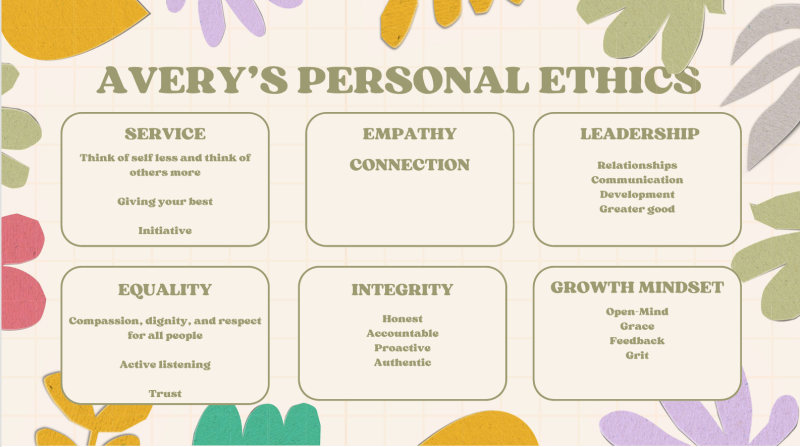
Code of Ethics
Belonging Statement Explanation
Belonging Strategy
The Intercultural Development Inventory is a useful resource for improving self-awareness. I perceived myself as having an intercultural competence of 123.13, which would rank within the Acceptance position on the Intercultural Development Continuum. However, my Development Orientation, which describes my actual position on the continuum, was only 93.68. This ranking places me in the Minimization category on the Intercultural Development Continuum. The Minimization ranking is characterized by “a tendency to highlight commonalities across cultures that can mask important cultural differences in values, perceptions, and behaviors” (Moore, 2026, pp.12). My Orientation Gap was 29.45, which shows that I recognize myself as appreciating cultural differences; however, my real-life approach is over-focused on commonalities between myself and others.
My focus on finding commonalities is rooted in previous success focusing on things I have in common with others as a means of building relationships (Moore, 2026). My ability to build relationships aligns with the positions I have held, or continue to hold, where I am successful such as a Behavior Technician and a Patient Care Coach.
My pattern of focusing on commonalities can also be destructive in my pursuit of intercultural competence because I do not give adequate attention to important differences of diverse communities that should be better understood and acknowledged for others to be their complete authentic selves around me (Moore, 2026).
My new role as a patient care coach centers on my ability to guide patients through their Transcranial Magnetic Stimulation (TMS) sessions while practicing goal setting, structured gratitude, and journaling activities. Therefore, I am familiar with goal setting, and in order to improve my intercultural competence, this skill will be important. The first goal I want to pursue is to create a habit of focused reflection once a week. I understand that reflection and adaptation in the moment is crucial; however, I also know goals must be measurable and attainable. So, to begin, I will focus on deep reflection once a week. This reflection will help me think deeper about reactions I had to people or events during the week that illuminate biases that I still hold. These biases also have the potential to help me identify more aspects of my own culture, which is crucial to my intercultural competence progression (Livermore, 2011). By developing a better understanding of my own culture, I should be better able to attend to cultural differences of others (Moore, 2026).
I believe that my move to Colorado will be helpful in this pursuit. The Denver area is very diverse, and each day I see and interact with many people that are different than me. I also have the opportunity to observe people with different cultures and languages. Consistently being exposed to different cultures is helpful for me to identify aspects of my own culture that differ from others. This diverse community also helps me uncover implicit biases and assumptions that I still maintain that would not be discovered if I were always around individuals like me.
This goal will also force me to slow down, which is fundamental to deepening my insights and adjusting my behavior. One component of my own culture I was blind to until reading this resource was how focused on efficiency and speed I am. I drive fast. I think ahead to make things run smoother and faster, and my mind tries to take on everything at once. This leaves no room for new cultural information, so by choosing to deeply reflect once a week, I can slow down and begin to adapt (Livermore, 2011).
My second goal to improve my intercultural competence is to learn Spanish. I began using a language-acquisition app at the start of 2026; however, with my move, I fell out of habit. I believe this is a measurable and attainable goal because I have access to the app on my phone, so I can practice the language wherever I am each day. Learning a new language improves my intercultural competence because language and culture are wrapped together, and the act of learning someone else’s language can potentially inspire respect and help me understand how that person sees the world. It is also important that I use the diverse community with which I am a part to observe the nonverbal components of the language as well (Livermore, 2011).
My third goal is to increase my global awareness. This could look like scanning international news once a week. Generally paying close attention to the news impacts my mental health significantly; however, I also recognize that I am beyond privileged that I do not have to pay attention to global events. Increasing my global awareness improves my cultural intelligence and intercultural competency because a global perspective improves cross-cultural engagements. Further, having an overview of major historical and current events offers perspective on others’ reactions and behaviors (Livermore, 2011).
Anyone can improve their cultural intelligence, and doing so carries many benefits. Enhancing cultural intelligence is accomplished through fine-tuning skills such as holding conflicting concepts in tension with one another in order to adapt effectively cross-culturally. Holding contradictions promotes learning, creativity, and opportunities. The focus on improved cultural intelligence yields a better, more equitable world, appreciation of others’ beliefs, enhanced reflective capabilities, and improved complex thinking (Livermore, 2011). Cultural intelligence, specifically, the ability to hold two conflicting viewpoints simultaneously is invaluable to leadership. Good Leaders can support two opposing thoughts in their heads at the same time then produce a synthesis of the two viewpoints, which is classified as Integrative Thinking (Martin, 2009). Further, Irving Washington III (2019) states that compassionate leaders have better outcomes. Enhanced cultural intelligence and intercultural competency demonstrate an effort to understand and adjust to improve the circumstances of others, which is similar to the dictionary definition of compassion. Therefore, enhanced intercultural competence is associated with better leadership outcomes.
As I begin pursuing my goals listed above and slowly improving my intercultural competency, I hope that my ability to form relationships with others continues to blossom. My personal skills are a blessing that are fundamental to how I lead, so with increased perspective and self-awareness, I believe I can be a more effective leader. My self-reflection and increasing perspectives also promote authenticity, both for myself and those I am working with. I believe that the organization I am now working for aligns well with my personal values, which helps me feel a sense of belonging. My hope is that within my role, taking time to actively listen and get to know the patients to build meaningful relationships can help them feel a sense of belonging as well.
References
Irving Washington III. (2019). Authentic leadership for the future [Video]. YouTube.https://www.youtube.com/watch?v=oQrqH3VSJwYLinks to an external site.
Livermore, D. (2011). Strategies to increase cultural intelligence. In The cultural intelligence difference: Master the one skill you can’t do without in today’s global economy. AMACOM
Martin, R. L. (2009). The opposable mind: Winning through integrative thinking. Harvard Business Press.
Moore, T. (2026). Intercultural development inventory: Individual profile report—Education version (Prepared for Avery Mize). Intercultural Development Inventory.